
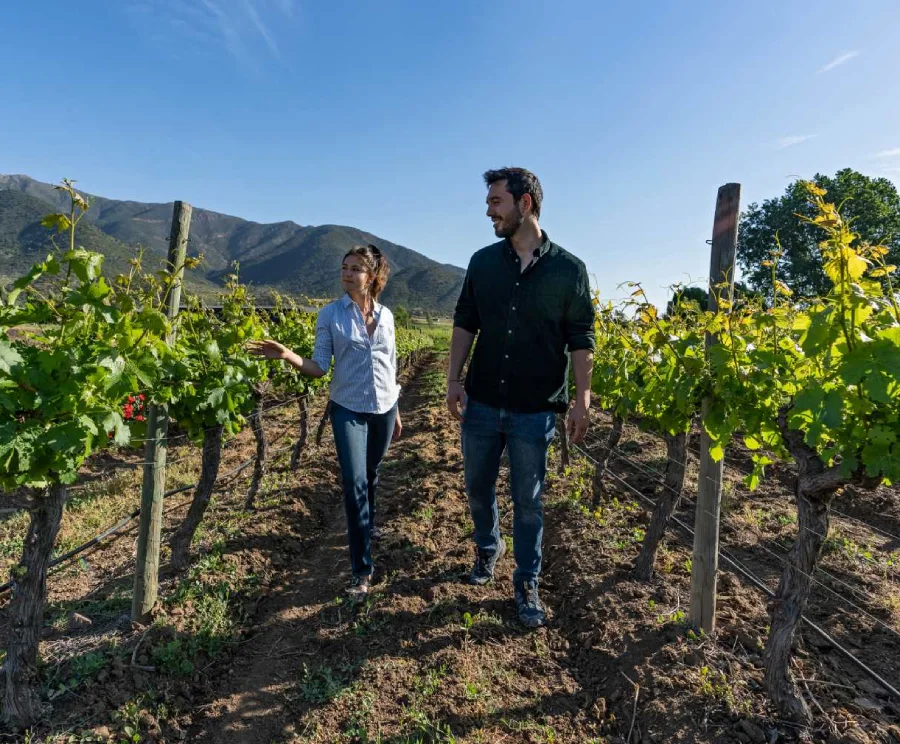
For decades, the Cachapoal Valley bore an unfair label on the Chilean wine map: that of the eternal runner-up. As prestigious wine critic Peter Richards MW aptly points out, this region has long played "second fiddle to its more celebrated neighbours, Maipo (to the north) and Colchagua (to the south)." With its wines described in the past by local experts as "fruity, without great ambitions," and trapped beneath the commercial shadow of the generic "Rapel" umbrella designation, the territory risked becoming the perennial absentee from the high-end market.
Yet, the winds from the mountain range are blowing with a fresh spirit. The global market demands diversity and quality, and Cachapoal has decided to shake off its apathy.
The Miracle of Alto Cachapoal: Stone, Altitude, and Freshness
To understand this renaissance, one must look up toward the slopes descending from the Andes. It is in Alto Cachapoal where viticulture ceases to be predictable and becomes an exercise in precision. With stony soils and a pronounced diurnal temperature range between warm days and cool nights—characteristics that Torreón de Paredes winemaker Yves Pouzet compares to having "big temperature fluxes from warm days to cool nights, just like the northern Rhône"—the terroir compels vines to perform at their peak.
Large-scale projects with a clear vision have successfully interpreted this geography. On the steep slopes of its Andean amphitheater, the joint venture Altaïr—driven by San Pedro and Château Dassault—has proven that extracting concentration without rusticity is entirely possible. In the words of its winemaker Ana María Cumsille, the zone yields wines featuring "concentration, but with elegant tannins and no rusticity like Maipo or Colchagua can give." Similarly, wineries like Casa Lapostolle (with its Las Kuras vineyard and commitment to Syrah), Anakena, and Torreón de Paredes advocate working with the mindset of gardeners, championing microclimatic diversity and small-scale yields.
The West and the Consecration of Carmenère
While the heights lean toward tension and an alpine profile, the western zone of the valley—which meanders alongside the Cachapoal River toward the coast, passing through San Vicente, Peumo, and Las Cabras—offers a warmer, more fertile face. It is here that late-ripening red varieties find their ideal habitat.
The historic La Rosa winery, with over 180 years of history and custodian of ancient palm trees over a millennium old, alongside wine giant Concha y Toro and its iconic work in Peumo, have proven that this land is second to none for Carmenère. As Adolfo Hurtado succinctly summarizes: "Peumo is warm, exposed to plentiful sunlight and is an outstanding region for Carmenère."
Toward an Independent Identity
With the consolidation of its own Wine Route and a portfolio of labels already competing toe-to-toe in international markets—from Altaïr’s elegant reds and Misiones de Rengo’s reservas to Concha y Toro’s acclaimed Terrunyo—Cachapoal is writing a brand-new chapter.
As Peter Richards MW concludes, the development of this land will require the exact same resilience as its monumental palm trees: "It will take time and perseverance if Cachapoal is to build a solid reputation." But the journey has finally begun bearing memorable fruit.
Original Full Article
You can consult the complete source text written by Peter Richards MW in Decanter via the following link:https://www.decanter.com/features/chiles-cachapoal-valley-247890/