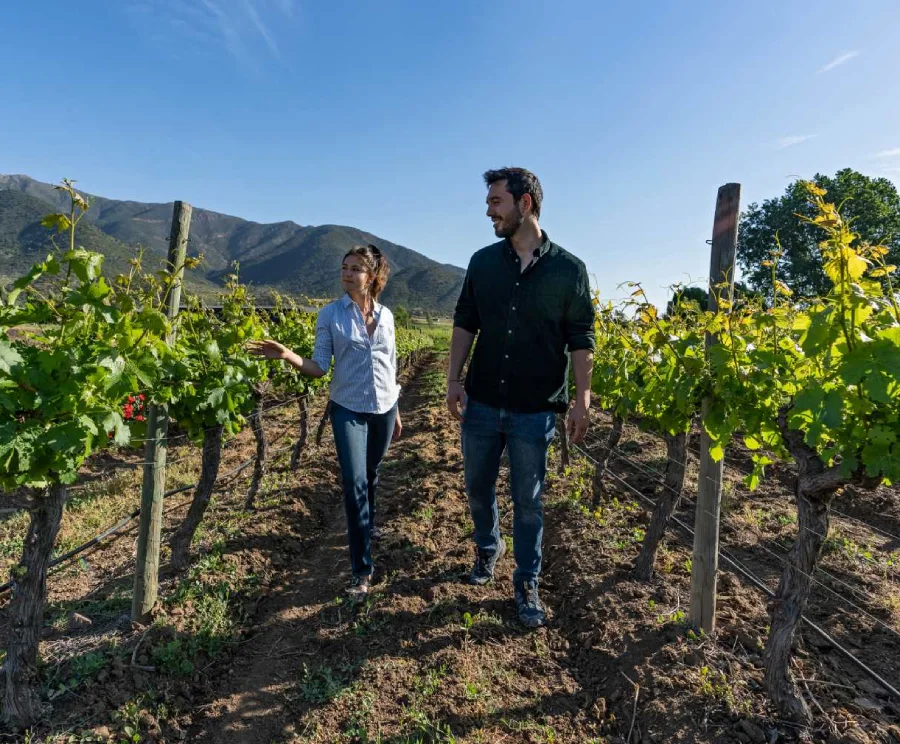
Peumo, the vineyard, the history, and the glass. A conversation with Marcio Ramírez, “Mr. Carmenere.”
There are stories that begin with a bottle. This one begins much earlier: in the leaves of a plant, in a vineyard where for years no one knew exactly what variety they were cultivating.
Carmenere has a touch of the paradox about it. For decades, it was present in Chile without Chileans knowing they were drinking it. It was confused with Merlot, grew mixed together in the same vineyards, and when it was finally identified in 1994, it ended up revealing an identity that today is an inseparable part of Chilean wine.
In the episode of Vinos con Maripepa dedicated to “Peumo and the Carmenere of Viña Concha y Toro,” from the YouTube channel De Tripas Corazón Vinos (watch the full video), winemaker Marcio Ramírez—known as “Mr. Carmenere”—guides the conversation toward one of the territories where this variety seems to have found its natural home: Peumo, in the Cachapoal Valley.
More than a viticulture class, the encounter ends up being a conversation about territory, patience, memory, and evolution. And about a vine that, after so many years, finally learned to speak with its own voice.
PEUMO: THE PLACE WHERE WAITING BECOMES WINE
To understand Carmenere, you must first understand its most basic need: time. It is not a variety in a rush. While other red varieties may be ready for harvest during February or March, Carmenere needs to stay longer on the plant—sometimes well into autumn, and under certain conditions, until early May.
This makes geography a decisive factor. In Peumo, the landscape plays in its favor. The area is protected by hills and receives the influence of Lake Rapel and the Cachapoal River, a combination that contributes to a stable climate and, most importantly, helps prevent late frosts.
For Carmenere, this condition is essential. The plant needs to retain its foliage longer to slowly complete the ripening of its clusters. If that process is interrupted too soon, the herbal notes appear that for years were one of the variety's main challenges.
Peumo also offers another key element: extremely deep soils, which can reach up to two meters without stones.
Ramírez explains that Carmenere does not need to live under excessive stress. It needs conditions of "relaxation." And perhaps therein lies one of the keys to understanding the character of the wines from this place.
Carmenere is not forced; it is waited upon.
A VARIETY THAT WAS THERE ALL ALONG
The history of Chilean Carmenere has an almost cinematic chapter. For decades, Carmenere plants were considered to be Merlot. The similarity between the two varieties in the vineyard meant no one questioned that identification too much.
Furthermore, Carmenere was considered extinct in Europe after phylloxera. Until 1994 arrived.
That year, a French ampelographer identified the differences between those plants and confirmed that what was considered a “late Merlot” was actually Carmenere.
The discovery changed history. But it also revealed something extraordinary: Chile had preserved a variety believed to be lost.
Peumo was among the places where those plantings had survived. There are vineyards there planted as far back as 1983, long before the official rediscovery.
It is impossible not to think about the number of times Chileans drank Carmenere without knowing it—hence why Ramírez’s expression—"Carmenere runs through our veins"—has a special force. It is not just a metaphor. It is the history of a variety that was present for decades in the country's winemaking culture, even though its true name remained hidden.
HOW TO RECOGNIZE A CARMENERE
In a blind tasting, Ramírez suggests paying attention to three elements: color, aroma, and palate.
The first clue appears even before bringing the glass close. Carmenere usually presents a deep, dark purple, whereas Merlot tends to show a paler hue.
There is also a telling clue in the vineyard. When autumn arrives, Carmenere leaves turn an intense red before falling. Merlot, on the other hand, tends toward yellowish and then brown tones.
Then comes the nose. Merlot leans toward red fruit: sour cherry, strawberry, and a touch of leaf litter. Carmenere leads toward darker fruits and spices, with a particularly characteristic note: black pepper.
And finally, the palate appears. Here the variety shows one of its most recognizable traits: greater weight and a silky, velvety texture that can recall dark chocolate.
It is no minor difference. It is part of Carmenere's personality.
FROM "MAKING UP" CARMENERE TO LETTING IT SPEAK
Perhaps one of the most interesting shifts in the recent history of this variety happened in the cellar.
For a period, the herbal character of Carmenere was something the industry sought to conceal. The solution involved using more oak and blends that allowed them to "makeup" or mask the variety.
But the perspective changed. Since approximately 2014, the trend began shifting toward less oak presence and a clearer pursuit of fruit, silkiness, and elegance.
The goal stopped being about hiding Carmenere’s personality. It became about understanding it. And that completely changes the conversation. Because when a wine stops trying to look like something else, it starts showing where it comes from.
TERRUNYO: THE FRUIT AS PROTAGONIST
The tasting brings the conversation to one of the most emblematic expressions of Peumo Carmenere: Terrunyo, linked to Block 27.
Ramírez presents it as an easy-drinking, fluid wine with non-aggressive tannins and a marked presence of fruit. Its purple color is intense, and its spicy notes are recognizable.
But perhaps the feature that best summarizes the evolution of Carmenere appears in a simple idea: less oak, more fruit. The wine seeks to clearly express the character of the variety.
And there is an interesting detail: that ease of drinking does not mean giving up aging potential. Terrunyo also shows significant aging capacity in the bottle.
All of this stems from a very precise origin: Block 27 in Peumo, a sector of balanced vigor that delivers fresh fruit.
WHEN A WINEMAKER TALKS ABOUT OTHERS
There is another moment in the conversation that deserves special attention. When Ramírez talks about contemporary Chilean Carmenere, he does not limit himself to Viña Concha y Toro labels.
He also speaks of other expressions, mentioning Clos de Luz (also located in the Cachapoal Valley), whose wines he highlights because he finds them especially rich on the palate.
It is a detail that could easily pass by in a conversation, but beyond the realm of wine, this fact is relevant. Ramírez is talking about other producers with recognition and respect.
He does not frame Carmenere as a competition where there is only one correct expression. He understands it as a variety capable of revealing different personalities depending on the territory and the work of each producer.
He also mentions the more powerful character that Apalta Carmenere can have, while describing Peumo's as more elegant and refined.
The conclusion is perhaps one of the best pieces of news for this grape: today there is diversity, but also quality. And that combination allows Carmenere to be interpreted in different ways and paired on different occasions.
FOUR WINES, FOUR MOMENTS AT THE TABLE
Carmenere doesn't end in the glass. It also converses with cuisine. And Marcio Ramírez proposes pairings that help understand the different styles:
- Terrunyo: Straight to the grill. Its freshness and good acidity draw it toward meats. Anticuchos and tenderloin appear as natural companions.
- Marqués de Casa Concha: Home cooking. Here the wine calls for comforting dishes. Meat or eggplant lasagna, potato pie (pastel de papas), and corn pie (pastel de choclo) are part of the proposal.
- Marqués Blue: Less is more. Its complexity and elegance lead Ramírez to prefer enjoying it on its own, though aged cheeses can also accompany it.
- Concha y Toro Carmenere: Returning to Chile. And here the pairing practically becomes a journey through traditional cuisine: charquicán with a fried egg, lentils, or pantrucas (traditional Chilean stews/dishes).
A GLASS WITH MEMORY
Chilean Carmenere has a history difficult to summarize in a single bottle. It is the story of a variety confused with another. Of vineyards that preserved plants for decades. Of a rediscovery that changed Chilean viticulture. Of winemakers who had to learn how to wait. Of an industry that went from trying to hide its characteristics to seeking its most authentic expression.
And it is also the history of a territory. Peumo does not appear in this conversation simply as a place where Carmenere is grown. It appears as a stage that allows the variety to complete its long cycle and reveal a particularly elegant and refined expression.
Perhaps that is why, in the end, Marcio Ramírez’s phrase best summarizes the bond between this grape and Chile better than any technical description.